The right hand side two-thirds of the user interface screen contains reports on the costs and benefits of the blowing and drifting snow solutions checked in the snow fence design section.
The first section contains the graphs of the net present value of the costs and benefits over the practice life. The second section contains ranges for the annual payments per acre for the practice life in real dollar terms. The third section has details on the cost and benefits for each solution. These outputs allow for an analysis of the cost and benefits for blowing and drifting snow solutions and allow the user to compare among the solutions.
Tool Outputs
Multi-practice Solution
While the tool is primarily designed to compare the four blowing and drifting snow practices (living and structural snow fences, standing corn rows, grading), the analysis can be extended to solutions that incorporate two or more practices. The first step to analyzing a multi-practice solution is to enter or re-evaluate the inputs. If the inputs have not been recorded already for a practice-by-practice solution analysis, then the data can be entered specifically for the multi-practice solution. If the data has already been inputted for the practice-by-practice solution analysis, then the user should re-evaluate the data.
The idea here is that a practice may have different inputs when it is the only solution as compared to when it is used in a multi-practice solution. If the inputs are not different between the single practice and multi-practice solutions, the user can move on to the next step. If they are different, it is recommended that the user start a new analysis and save it with a similar name but indicate that it is a multi-practice analysis (structural-grading). The second step involves averaging the benefits and adding up the costs reported by each practice that make up the multi-practice solution. The benefits are averaged because the cost-benefit tool assumes that the practices are 100 percent effective at eliminating the blowing and drifting snow problem. The costs of the practices are added because each practice will be built as part of the multi-practice solution.
Costs vs. Benefits
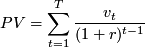
Present Value
The present value is the sum of the discounted value over the practice life (T). The future values (v) are discounted to account for the opportunity cost of the investment or the preference of individuals for the present. It is calculated using the following formula, where r is the discount rate for the agency.
Benefits
The benefits for year (t) are just the sum of all the benefits for that year.

The present value of the benefits is:

Travel
The travel benefits are calculated from the traffic and the number of events in the blow ice section. The formula is below, where cauto is the value of travel time for auto occupants and cheavy is for heavy commercial traffic. Both of these values are in the parameters for the agency.

Auto Travel Time
The formula for calculating auto travel time is below, where mph is the traffic speed, mphreduction is the reduction in traffic speed, NBlowIce is the number of blow ice events, TBareLane is the time to regain bare lane, AADT is the annual average daily traffic, HCAADT is the heavy commercial traffic, Ncaroccupancy is the car occupancy parameter for the agency and L is the snow problem length.

Heavy Commercial Travel Time

Costs
The cost for year (t) is just the sum of all the costs for that year.

The present value of the costs is:

Net Benefits
The net benefits is the present value of the benefits minus the present value of the cost.

When the NB is greater than zero, the benefits are higher than the costs. When the NB is equal to zero, the benefits and costs are equal. When the NB is less than zero, the benefits are lower than the costs.
Benefit-Cost Ratio
The benefit-cost ratio (BCR) is the present value of the benefits divided by the present value of the costs.

When the BCR is greater than one, the benefits are higher than the costs. When the BCR is equal to one, the benefits and costs are equal. When the BCR is less than one, the benefits are lower than the costs.
Internal Rate of Return
The internal rate of return (IRR) is the annual rate of return for an investment. Calculation of the IRR requires the usage of a numerical algorithm that can have difficulty coverage and/or finding a single unique solution. Therefore, we use the modified internal rate of return (MIRR) which can be calculated directly from the BCR.

Note that this value is in decimals, so an MIRR of 0.15 is a 15 percent internal rate of return.